
Equipment · 17 October 2026 · 4 min read
All-black solar panels: the look, the output, what to ask
All-black panels sit quietly on a dark roof. Here is what they are, what the datasheets say they give up in output, and the questions worth asking.
By Michael John, Central Solar
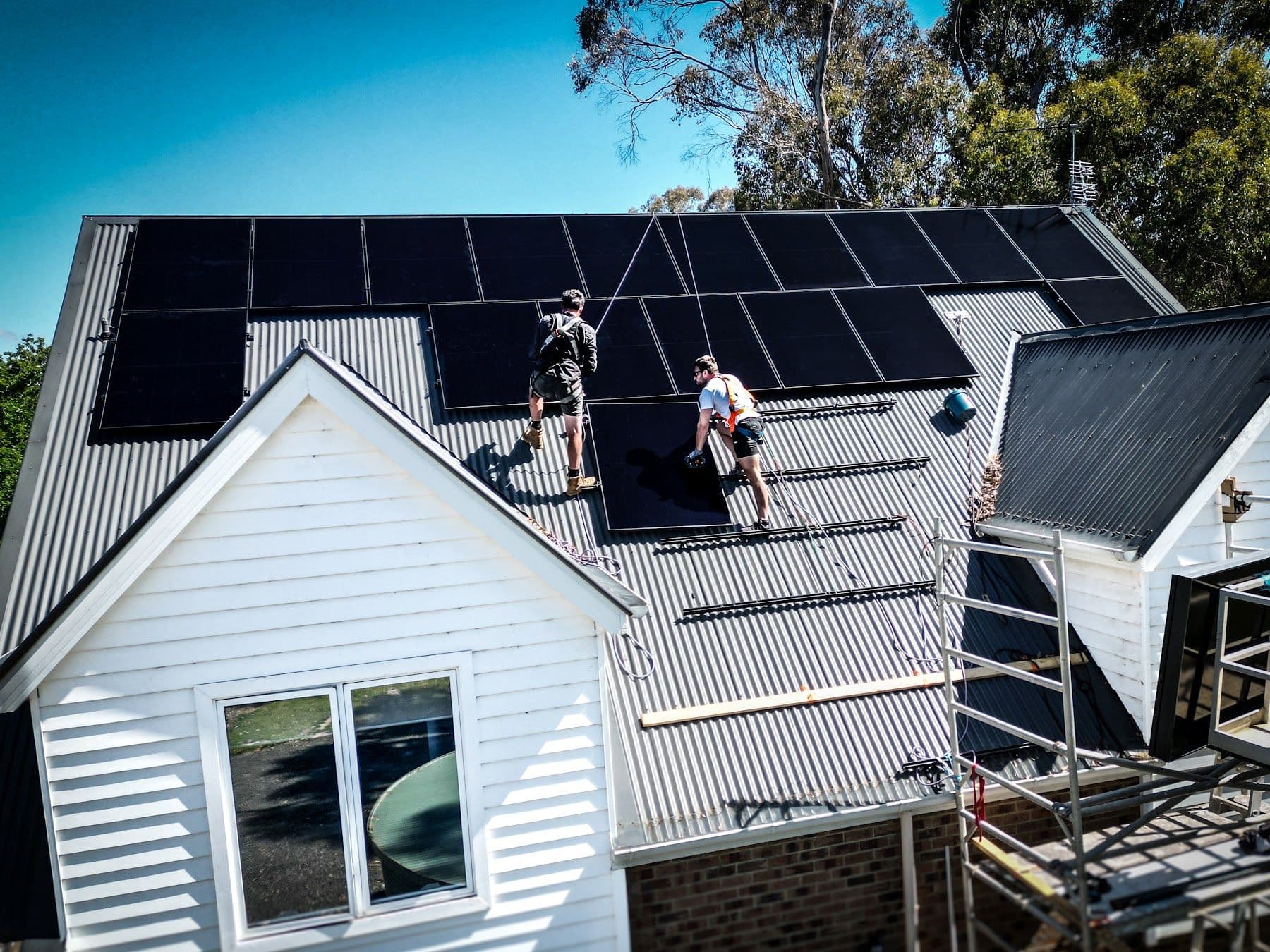
All-black panels cost you a little output on paper, usually a few watts a panel, and give you a roof that looks like one clean dark shape instead of a grid. For most homes that is a small price for a much tidier street view. Here is how to see the difference for yourself before you choose.
What makes a panel "all-black"
Look closely at a standard panel and you will see the cells sitting on a light coloured backing, with thin pale lines showing between them, often inside a silver frame. An all-black panel uses a black backing sheet and a black frame, so the cells, the gaps and the edges all read as the same dark colour. From the street it looks less like equipment and more like part of the roof, especially on charcoal or black tiles and Colorbond.
Some panels are sold as "black frame" only. They swap the silver frame for black but keep the light backing, so you still see the grid. If the look is what you are paying for, check that both the frame and the backing are black.
What it costs in output
The fairest way to measure this is to compare two panels from the same maker, same series, same size and same cells, where the only real change is the colour. Jinko's Tiger Neo datasheets let you do exactly that.
- The standard version (54HL4R-(V)) is rated from 435 W to 460 W, with module efficiency up to 23.02%.
- The all-black version (54HL4R-B) is rated from 430 W to 455 W, with efficiency up to 22.77%.
Both are 1762 by 1134 mm, both use 108 N-type cells, and both list the same temperature coefficient (minus 0.29% per °C) and the same 0 to +3% power tolerance. Each power class of the all-black version sits 5 W lower, which is about 1% at the top of the range.
The usual explanation is that a white backing bounces some of the light that lands between the cells back up into them, while a black backing absorbs it.
On a real roof, that is modest. Fifteen panels at 460 W come to 6.9 kW. Fifteen of the all-black version at 455 W come to 6.825 kW, a difference of 75 W across the whole array. Roof direction, shading and pitch will move your output far more than that.
When it matters more
Where every panel counts (a small roof, a tricky shape, or a home that wants as much as possible from limited space) those few watts a panel add up, and it is worth seeing both options side by side. Where the roof has room to spare, the difference can be covered by the layout.
Looks can matter for practical reasons too. If the front roof faces the street and the owners would rather not see an obvious array, all-black panels and a layout that leans on the side and rear planes can make solar an easy decision rather than a reluctant one.
What to ask before you sign
- What is the exact model number? Ask for the datasheet and read the all-black rating, not the headline figure for the series.
- Is it fully black or black frame only? The datasheet or the product photos will show the backing colour.
- How does the quote compare like for like? If you are weighing two quotes, compare the same wattage class, not one quote's all-black panel against another's standard one.
- What are the warranties? Jinko's all-black Tiger Neo sheet lists a 25-year product warranty and a 30-year linear power warranty, with 1% degradation in the first year and 0.40% a year after that. Other makers differ, so read the sheet for the panel you are offered.
- How will it look on my roof? Ask to see the layout drawn over a photo of your home, so you can judge the look from the street before anything goes up.
How we handle it
All-black panels come standard on our Premium and Balanced tiers, and every panel we fit across all three tiers carries a 25-year warranty. If you are trying to decide between the look and a few extra watts, we can draw up both layouts on your roof and the difference in system size, so you can make the call with the numbers in front of you.
See how the three tiers compare, panels included, on our solar systems page.
Michael John
Central Solar, New Gisborne